
Although I have always been interested in my family ancestry, I was never required to formally research it. Of course, while growing up, I have always heard the stories from my grandparents, parents, aunts, and uncles. I have always enjoyed hearing the stories of my relatives, yet, I only took them at face value and never asked targeted questions. I did not know why my great great grandfather came over to America, only that he was from Hungary. I have conducted interviews with my uncle and grandparents and I was surprised to learn what I have about my own migrant story.
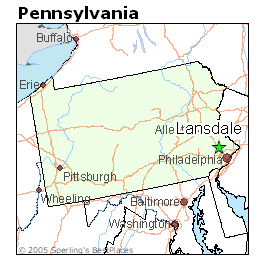
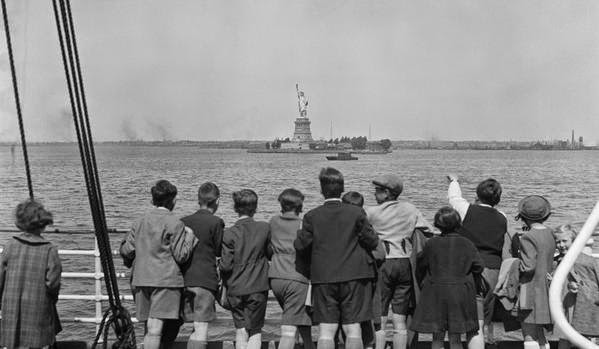
My great great grandfather’s name was Geza Molnar Kovacs, and he was born on June 19, 1889 in Temes Megye, Hungary. He had a wife, my great great grandmother, Elizabeth, who was also born in Hungary, and had four children: John, Raymond, Helen, and Frank. While it is unknown what my family’s living conditions were in Hungary, my great great grandfather was a farmer, and the believed reason for my family’s migration to the United States was in an effort to escape the Romanian Empire and a communist-ran nation as well as create a better life for themselves. My great great grandfather was thirty-six years old when he migrated from Port Fiume, Italy on December 3, 1908. Based on research that I conducted, I came to learn that the Port of Fiume was owned by Hungary, and this is why my great great grandfather traveled from this port (Balch, 1910). He traveled solo on a ship, Slavonia, and arrived at Ellis Island on December 29, 1908. His wife and children migrated to the United States the following year where they settled and resided in Lansdale, Pennsylvania. I asked my uncle why they had decided to move and live in Pennsylvania, and he believed that once Geza arrived he was asked what sorts of skills he possessed and was directed where he would be of use. For those of you who may be unaware, Pennsylvania is a HUGE farming state; the entire central part of the state is farms. As I furthered my research, I came across 2010 Census Data that disclosed which states have the greatest Hungarian American populations. To no surprise, Pennsylvania is the fourth state with the largest Hungarian American population (U.S. Census 2010). This further suggests that when Hungarians migrated to the United States, Pennsylvania was a hot bed for their communities. This is another reason as to why my great great grandfather would have chosen to settle in Pennsylvania as there may have been a community of Hungarians where he could still participate in his culture. Geza ended up getting a job at Marten Central Farms. The house that my family lived in in 1930 cost about ten thousand dollars and they owned a radio. My great great grandfather also changed his name to Raymond Smith, and became a legal citizen on September 14, 1927.
As I conducted outside research on my ethnic group, I came to find that there were many different races within Hungary, and the “true” Hungarian was referred to as a Magyar (Warne 1916). Geza was considered a Magyar, and in 1914, there were 47,000 immigrants, forming the largest number of any single group from Austria-Hungary (Warne 1916). Warne also disclosed that most of the immigration movement to the United States from Eastern Europe was due to a higher demand for labor as well as higher wages. Since my family wanted to migrate in the hopes of creating a better life, moving to a nation where there was a higher probability of receiving a job as well as better pay would attract my family to the U.S. Other individuals within my ethnic group also migrated for other reasons such as dissatisfaction with political and social conditions and escaping military service (Warne 1916). Again, my great great grandfather wanted to escape the Romanian Empire.
I also came to learn that my family migrated at an interesting time. Hungarian individuals did not frequently migrate to the United States; in 1880 less than 200,000 migrated, however, by 1910, more than 1,600,000 migrated (Warne 1913). Yet, in 1907, migration dipped as the United States was suffering a financial and commercial depression, causing immigration to drop in the two years following it (Warne 1916). This shows me that my great great grandfather traveled to America at a time where not much migrating was taking place. This also makes me believe that the reason for my families migration was more based on dissatisfaction with political and social aspects in Hungary than their financial situation. As we have learned throughout the course, those who immigrate tend to have money, because it costs money in order to travel. If I consider how Geza migrated, he boarded a boat and moved and settled in Lansdale, Pennsylvania where the rest of his family joined him a year later. In order for Geza to do this, he first needed to spend money to travel from Hungary to Italy so he could board the ship. He then, also, needed to purchase a ticket to travel on the boat to Ellis Island, and lastly, he had to have the funds to purchase a house once he got to America.
As I reflect on the theories and policies we discussed in class, a theory that I believe fits my families story the most is the segmented labor market. This theory states that workers find jobs that they are suited for while employers find workers who are able to perform the job; from here, wages are determined between the two parties (Lecture Notes 9/6). While I am not sure how my great great grandfather obtained his job at the farm, it seems as though this theory would fit best. While it seems as though my family’s migration would not fit the New Economics of Labor, this theory states that it is problematic to think of migration as an individual decision, rather we should think of the decision to migrate as a household decision. It is often likely that families that migrate due to this theory do so in order to diversify income. They normally will send one individual from the family to work, make money, and send this money back home. Moreover, the individual who goes to the host country does so with a plan to eventually return home. Geza had no intention to return back to Hungary. However, it is notable that he was the only one who came to the United States first, as the rest of his family joined him a year later. This could have been because he wanted to make sure the country would be suitable for the rest of his family. This also could have occurred because he may have wanted to grasp bearings himself and have a place for the rest of the family to settle once they arrived; this way it would be a smoother transition for his wife and children. Further, World Systems Theory suggests that it is through changes in the political economy that comes with entry into the world’s capitalist systems shapes migration (Lecture Notes 9/6). As I mentioned prior, my family was leaving Hungary in order to escape the Romanian Empire and Communist-ran nation. With this, Hungary also began industrializing by increasing the machine building industry (Acemoglu and Robinson 2006). Thus, with this increased industrialization, my great great grandfather migrated during this influx of capitalistic production, just as World Systems theory predicts. Apart from theory, the policies that were in effect during the time of my family’s migration did not make it particularly difficult to migrate. The main restriction for when my family migrated was that they had to know how to speak English as this was enforced in 1906, and my family did not arrive until 1908 and 1909. This was implemented as the United States was trying to keep the Chinese out of the country and thought by restricting language, they would be able to inspect those who were trying to come over the boarders (Lecture Notes 9/13). This shows that if my great great grandfather had wanted to migrate and he was from Asia, specifically China, he would have a very difficult time getting into the United States. Another policy that was enacted prior to my family’s arrival was the Expatriation Act that stated that women would lose their citizenship if they married an immigrant man, but men would not if they married an immigrant woman (Lecture Notes 9/13). While my great great grandparents were married, this would be important for my great great grandmother to know and understand if for some reason her and Geza decided to get divorced. Lastly, if my family had decided to wait longer to migrate, say ten or so years, they would have had a much more difficult time migrating to the United States as it was in 1917 that the U.S. became concerned with Southern and Eastern Europeans coming to our nation. If my family had decided to wait, they would have had to pass a literacy test (Lecture Notes 9/13).
I learned a lot about the history of my family and how we came to be in America. I am excited to see what else I will uncover in my upcoming blogs!
References:
Balch, E. G. (1910). Our Slavic fellow citizens. Charities publication committee.
Warne, F. J. (1913). The immigrant invasion (Vol. 3). Dodd, Mead.
Warne, F. J. (1916). The Tide of Immigration. New York: Appleton and Company.
 From Hungary to America