
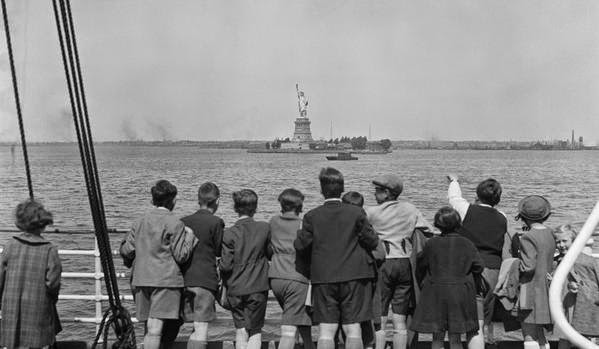
As I reflect on this project over the course of the semester, there are many things that I learned about my family that I did not know before. Originally, I had just known that my great great grandfather had come over to the States from Hungary, but I had not known the year or why he came. I really enjoyed this project as it required me to dig deeper into my ancestry, as well as have conversations with my grandparents, uncle, and mom that I normally would not have. Being able to talk to my family about something that we share in common was really fun, and more importantly it was really neat being able to relate my family migration to my peers unique stories, as well as to the concepts we were learning in class. The most interesting aspect that I learned about my history was the date that Geza came over. He came in 1908, and as we had learned in class, in 1906, the United States was cracking down and requiring immigrants to know English (this was in an effort to inspect individuals and keep out the Chinese). This was interesting to me, as I had not known if Geza spoke English well when he arrived, I had only heard stories from my mom where she remembered he spoke very well, but with a cool accent. Another aspect I found interesting is, again, in relation to the time my great great grandfather decided to come over. In 1917, America was becoming increasingly concerned about Southern and Eastern European immigrants, so they required them to pass a literacy test to get into the country. This stood out to me because Geza had come only 9 years prior to this, thus, who knows if he would have passed the test and been able to get into the United States. This small detail could have affected if my family would have been able to migrate here. Moreover, if my family had migrated from a different country at the same time, say China, we would have had a very difficult time getting into the States, as the Chinese were excluded from entry. Lastly, in 1921/1924, the United States required all individuals coming to already have a Visa before their entry. Geza had just got on a boat and traveled to Ellis Island. He had no Visa and did not even get citizenship until September of 1927, nineteen years after being in the United States. This made me wonder: was Geza an ‘illegal’ immigrant for twenty years before becoming a citizen? In relation to present day, I found this interesting because many individuals in our nation get angered by those who are here ‘illegally.’
In relation to migrating at a different time, it is evident that my classmates had similarities and differences to my migration story. Reading Izzy’s blog, I learned that her grandparents had came after Irish individuals were considered white. Prior, Irish individuals were not seen as white and were often discriminated against in the United States and seen as a “threat.” I found this to be very interesting as throughout America’s history, we have always labeled certain immigrant groups as non-white in order to ‘other’ them and establish them as a perceived threat. I also found that Izzy and I differ in our family migration as both of her grandparents had to go to the Dublin Embassy in order to be screened for travel to the United States. This differs from my story as Geza had just bought boat tickets and journeyed to New York.
In contrast, Hieu and I have very different migration stories. Hieu is the first of his family to come to the United States as an international student. However, like many immigrants, Hieu came to the United States in search for a different life and higher education. Reading about the history of Vietnamese individuals who tried coming to the United States, it is very apparent that they had a very difficult time getting in, especially during and after the Vietnam War. Yet, even though Hieu and I have very different migration stories, we do share similarities. As I mentioned in our class discussion last month, like Hieu, I really hated PC my freshman year and wanted to go back home. While I was not from another country, PC seemed very foreign to me as it was very different than what I was used to. I am from small town Pennsylvania (the country as many would say at school, LOL) and PC was an extremely different environment for me where I felt like an outsider.
Hieu also experienced similar feelings as he was extremely homesick and had a difficult time popping his comfort bubble. I feel as though both Hieu and I held on to our identity from back home that it was difficult for us to assimilate in this new environment. I really enjoyed learning this, as this shows me that even though Hieu and I have extremely different experiences in our migration stories, we still shared very similar experiences.
Lastly, in reference to Mary Waters Ethinic Options, Geza and the rest of my family that migrated held Hungarian roots close to them as they still spoke the language, made traditional meals, and celebrated certain holidays. However, for their grandchildren and forward, we are able to engage in symbolic ethnicity since we are seen as ‘white.’ This means that we are able to participate in certain customs when we want to. An example of this is my family cooking a traditional Hungarian meal. Those who are seen as non-whites are unable to do this because they are automatically seen as different and coming from somewhere other than America, thus their customs must be very different from ours. My family does not get asked where we are from because we look American and we do not have anything that makes us stand out from others.


 From Hungary to America